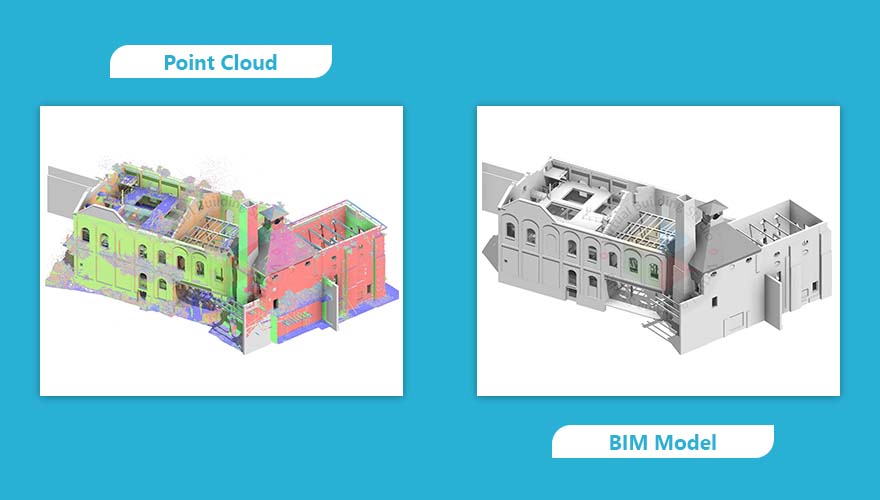
Now-a-days, point clouds and laser scanning have become essential tools in the AEC (Architecture, Engineering, and Construction) sector for gathering exact site data and producing precise digital representations of existing structures. To make sure a building or site is fully covered, scanning is generally performed from various angles. Point cloud registration, which combines separate scans into a single, cohesive, and spatially accurate dataset, is a necessary step before these scans can be utilized for Building Information Modeling (BIM). A reliable Scan to BIM workflow starts with this phase.
If the registration procedure is not done correctly, even the most advanced laser scanner cannot produce reliable results. This blog will discuss the importance of point cloud registration, typical problems encountered by experts, and how it directly impacts the precision and usefulness of BIM models.
Understanding What is Point Cloud Registration?
Point cloud registration is the process of bringing together and aligning multiple 3-dimensional laser scans into one high-resolution dataset for either an entire site or a building. Due to the size of the area, complexity of geometries, and hidden surfaces that need to be captured, all renovation, retrofit, or remodeling projects are likely to need multiple scans from multiple viewpoints.
The next step is to register each of the individual scans so that they properly align in space. This can be done automatically using algorithms such as ICP (Iterative Closest Point), which aligns overlapping areas based on geometry, or it can be done manually by a human technician registering features or common points between scans.
Very often, both options rely on reference targets or natural specs such as corners, edges, or columns to establish accurate registration. Accurate registration is crucial for professional Scan to BIM Services in USA because even minor misalignment at this stage can lead to geometric errors and deviation throughout the BIM project.
What Happens When Point Cloud Registration Fails?
If the point cloud registration fails, the scan to BIM project will suffer. When overlapping scans are not registering well, there is a ghosting effect, resulting in double lines, fuzzy edges, and distorted geometry like bowed walls, duplicate columns, and uneven floors. Overall, the data set is unreliable and difficult to predict because of what is visually apparent.
Unfortunately, it doesn’t end with the failed registration. In BIM, poor registration means errors will cascade.
- Untrustworthy Dimensions: Since the model dimensions are misaligned, you will end up with inaccurate design intent.
- Coordination Nightmares with Clash Detection: While the pipe may visually register well in the BIM model, the beam may overlap with a beam on site once the scans are inaccurately registered, leading to null coordination.
- Fabrication Flaws: If prefabricated components, such as ducts or steel beams, are based on poor geometry, they will not align properly.
- Project Delays and Cost Overruns: If errors in registration are fixed afterward, the work will take longer, disrupt workflow, increase scanning costs, and in the end, the profitability of the project will be impacted.
Even if the scan produced the highest quality and most detailed point clouds, it doesn’t matter without registration. This is the value of registration, but it only takes place in the earliest stages of the workflow.
The Role of Point Cloud Registration in the Scan to BIM Workflow
In a standardized Optimize Scan to BIM workflow, the initial step is laser scanning. This involves capturing millions of spatial data points from a variety of locations in order to record every detail of a building or site. These raw scans are then processed through the point cloud registration step, which aligns and merges the scans into a consistent and spatially correct dataset, which is the basis for modeling. After the registration is completed, the data is imported into software platforms such as Revit or Archicad to create precise BIM models, which will be further used for design, renovation, and facility management.
Here’s what the role and significance of registration in the Point Cloud to BIM Process:
- Before modeling: It makes sure the scans are aligned to one coordinate frame.
- During modeling: Every line, wall, or surface placement is directly dependent on accurate registration.
- After modeling: This indicates how accurately an individual can trust their measurements and spatial relationships.
For example, if the registration is off by a few millimeters, floors may appear to slope or walls to shift out of plumb, which causes issues for design coordination. Firms specializing in Scan to BIM services in the USA rely on accurate registration in order to provide models that accurately capture real-world conditions and eliminate unintended errors downstream in the project life-cycle.
Common Errors in Poor Point Cloud Registration
Inadequate point cloud registration can result in small yet notable mistakes that propagate throughout the entire Scan to BIM workflow. Frequent mistakes include scan closures that are misaligned because of utilizing an inaccurate number of reference points or even questionable points of reference, leading to twisted geometries. Overlapping scans with shifts usually cause gaps or an overall ghostly presence of the building structure, which distorts the elements within the building and creates measuring inaccuracies. When there are no reference coordinates, the scans may simply be wrongfully scaled or rotated in any direction and misalign the model entirely. Software errors, such as placement of the targets, incorrect overlap measures, and human error may also cause uncertain accuracies. Though these problems may seem overly trivial initially, they compound in the modeling stage, causing walls, floors, or structural components to appear warped or positioned incorrectly. In the end, poor registration results in faulty and inaccurate BIM models, unreasonable data for the project, and additional and expensive rework during later design, coordination, or construction stages.
Advantages of Accurate Point Cloud Registration
A crucial first step in producing trustworthy BIM models is accurate point cloud registration, which has advantages for the duration of the project. Because even small misalignments can lead to significant modeling mistakes, registration is given top priority by companies providing Point Cloud to BIM Services in USA. Accurate measurements are made possible and the possibility of design errors is decreased when all scans are properly registered and aligned into a single, cohesive dataset.
They include important advantages:
- Accurate Geometry: Wall, floor, and structural elements have true measurements, so the BIM model is an accurate digital representation of the physical environment.
- Reliable Measurements: Architects and engineers can take measurements, conduct quantity take-offs, and plan renovations or retrofits with confidence.
- Efficient Clash Detection: Accurate registration allows for MEP and structural components to work together with minimal clashes in the field.
- Reduced Rework & Costs: Correctly registered scans eliminate inaccuracies that would end up costing time and money in fabrication or changes in the field.
- Streamlined Collaboration: A single dataset ensures that all team members and stakeholders can work from the same accurate information, improving the flow of communication and reducing delays.
- Improved Decision Making: High-quality models also allow for confidence in decisions made in design, construction and facility management.
The investment in accurate registration at the start allows Point Cloud to BIM Services to yield models that are accurate, reliable, and effective, ultimately benefiting time and cost throughout the project lifecycle.
Conclusion
To create precise and accurate BIM models, point cloud registration must be done accurately and with precision. If the scans are not properly aligned, there are instances where even the highest level of detail can result in mistakes, additional, expensive work, and ultimately, unreliable project delivery. Firms should therefore make quality registration procedures a clear priority, invest in the quality of software tools they use and implement consistent and reliable quality validation checks, to ensure their models are conducive to real-world conditions. For AEC teams that are relying on Scan to BIM workflows, high-quality point cloud registration is not merely a technical step, but is the foundation of a reliable digital model that promotes accurate design, effective coordination, and well-informed decision-making throughout the entire project process.


