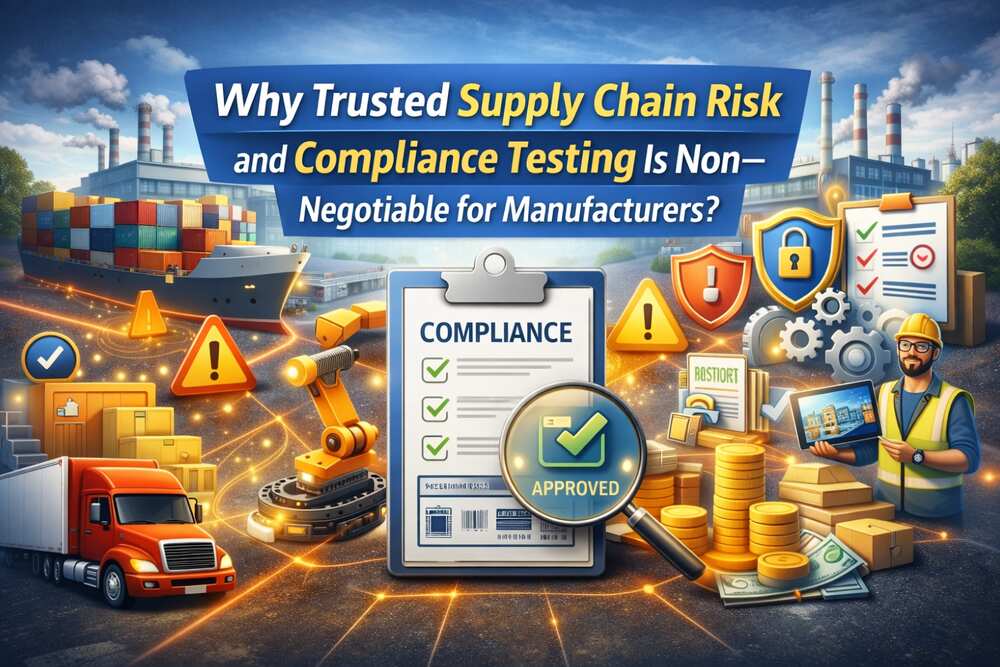
The contemporary production relies on the intricate international supply chains. Consequently, all the production stages have been exposed to risk. Thus, manufacturers are required to cushion operations by using organized assurance schemes. Trusted supply chain risk and compliance testing is the new form of sustainable success.
The Growing Complexity of Manufacturing Supply Chains
The globalization increased sourcing opportunities to manufacturers throughout the world. Nonetheless, multi-level supplier systems minimized visibility and influence. As a result, minor compliance breaches have the capacity of causing significant operational upheavals. In addition, the digital integration has augmented reliance on third-party systems and information.
Concurrently, sourcing strategies are still affected by the geopolitical instability. Besides, environmental and ethical laws become stricter annually. As such, manufacturers are forced to ensure that they have unremitting supervision among suppliers. These challenges are not known until some damage is inflicted without testing.
Understanding Supply Chain Risk and Compliance Testing
Testing of supply chains measures supplier controls, procedures and governance structures. In particular, it confirms the compliance with regulatory and contractual requirements. Moreover, the testing can prove whether the risk controls have been successful in practice. Manufacturers can so get evidence-based confidence rather than assumptions.
Informed decision-making is also upheld in this approach. In the case of one example, procurement teams evaluate the preparedness of a supplier confidently. Similarly, the leadership teams are provided with transparent risk inputs. Finally, testing enhances the governance throughout the entire supply chain.
Why Trust Is Critical in Supply Chain Testing
Credibility is based on trust in the testing results. Results that are not independently validated usually do not have reliability and acceptance. In turn, manufacturers need to have proven-unbiased testing partners. In addition, experts who are trusted use uniform and standardized assessment techniques.
Trust is also enhanced by sector specific knowledge. Thus, manufacturers are provided with insights that are based on actual operational risk. Generic audits, on the contrary, often fail to identify key compliance issues. Reliable testing guarantees results based on practice.
Princeps Supply Chain Testing: Delivering Reliable Assurance
Princeps can offer expert-led and independent supply chain risk and compliance testing. It is worth noting that Princeps Supply chain testing is concerned with the real-life manufacturing issues. Their procedure is a blend of technical and commercial insensitivity. Consequently, manufacturers obtain applicable and pertinent insights.
Princeps supports end-to-end supplier assessment programs. Additionally, services align with industry regulations and international standards. Therefore, compliance requirements integrate smoothly with daily operations. Manufacturers seeking dependable assurance can explore solutions at Princeps Official Website.
Regulatory Pressure Makes Testing Essential
Regulators have become insistent on compliance evidences. The manufacturers are required, therefore, to be engaging in practices of risk management. Written policies are however no longer enough to undergo regulatory scrutiny. Testing is used to determine whether the controls are working as planned.
The penalties of non-compliance are still on the rise in the industries. As an example, fines, recalls, and halt production hurt profitability. More importantly, brand reputation is eroded in the long term. Trusted testing consequently safeguards both financial as well as brand value.
Continuous Testing Reduces Operational Risk
Static audits are ineffective in dealing with dynamic threats. Rather, constant testing is flexible in regard to fluctuating supply. As a result, manufacturers spot risks at an earlier stage and react more quickly. In addition, continual evaluations facilitate the perpetual improvement programs.
Clear performance expectations also benefit to the suppliers. Due to this, teamwork within the chain of supply will enhance. In the long run, collective responsibility bolsters operational resiliency. Ongoing testing makes compliance a strategic position.
Operational and Strategic Benefits Beyond Compliance
Efficiencies in manufacturing operations are improved with efficient testing. Approved suppliers decrease waste of time, mistakes and reworking. Also, inventory and logistics decisions are made better through risk-aware planning. Thus, the operational costs are decreased gradually.
Trusted testing also makes innovations safe. Meanwhile, new suppliers are brought on-board more quickly by means of organised evaluations. In this way, manufacturers scale in a way that does not expose them to higher risk. The strategic growth is corresponding to compliance goals.
Building a Culture of Accountability and Resilience
Reliable supply chain testing promotes accountability at all levels. Commitment to leadership is an indication of compliance and transparency. As a result, teams put quality and risk awareness on a daily basis. The suppliers harmonise their practices.
Gradually, the culture of accountability is inculcated in the organizational culture. Therefore, the concept of resilience becomes proactive. Reliable testing helps us to ensure the stability and trust of the long-term. Manufacturers receive confidence that systems can be put into pressure.
Conclusion: A Non-Negotiable Requirement for Modern Manufacturers
Supply chain risk and compliance testing is no longer an option. On the contrary, it is a source of resilience and development. Reputable partners such as Princeps provide transparency by providing evidence-based confidence. Thus, Princeps Supply chain testing is still critical to the contemporary manufacturers.
The decision makers who do invest in trusted testing minimize the uncertainty. Consequently, they safeguard operations, reputation and compliance. The passive approach, though, welcomes interference and defeat. Trusted testing is indeed non-negotiable to manufacturers.


