Introduction to Precision Timing in Packet Networks
Modern communication networks are evolving rapidly. With the growth of mobile networks, cloud computing, data centers, and high-speed packet transport, accurate timing and synchronization have become critical requirements. Unlike traditional circuit-based networks, modern packet networks are asynchronous by nature. This makes synchronization more complex and much more important.
Technologies such as LTE, 5G, financial trading systems, and smart grids rely heavily on precise time alignment between network elements. Even a small timing error can affect performance, reliability, and service quality. To solve this challenge, modern networks use Precision Time Protocol (PTP) and PTP Grandmasters as the main source of accurate timing.
This article explains what a PTP Grandmaster is, why it is important, how it works, and how to choose the right one for modern networks.
Why Synchronization Is Critical in Modern Networks
Frequency, Phase, and Time Synchronization
In older synchronous networks like SONET/SDH, only frequency synchronization was required. However, modern packet-based networks need much more than that. They require:
- Frequency synchronization – keeping clocks running at the same rate
- Phase synchronization – aligning clock signals accurately
- Time synchronization (Time of Day) – ensuring all devices share the same absolute time
In many applications, accuracy is required at the nanosecond level. Without proper synchronization, data loss, interference, and service degradation can occur.
Importance in LTE and 5G Networks
Mobile technologies such as LTE and 5G depend heavily on precise timing for:
- Coordinated radio transmission
- Seamless handovers
- Reduced interference
- Efficient spectrum usage
Even a small timing error can impact call quality, data speed, and network stability.
What Is Precision Time Protocol (IEEE 1588)?
Precision Time Protocol (PTP), also known as IEEE 1588, is a packet-based protocol designed to deliver accurate time synchronization over Ethernet networks.
Unlike older timing methods, PTP works efficiently in packet networks and provides very high accuracy when supported by proper hardware.
How PTP Works
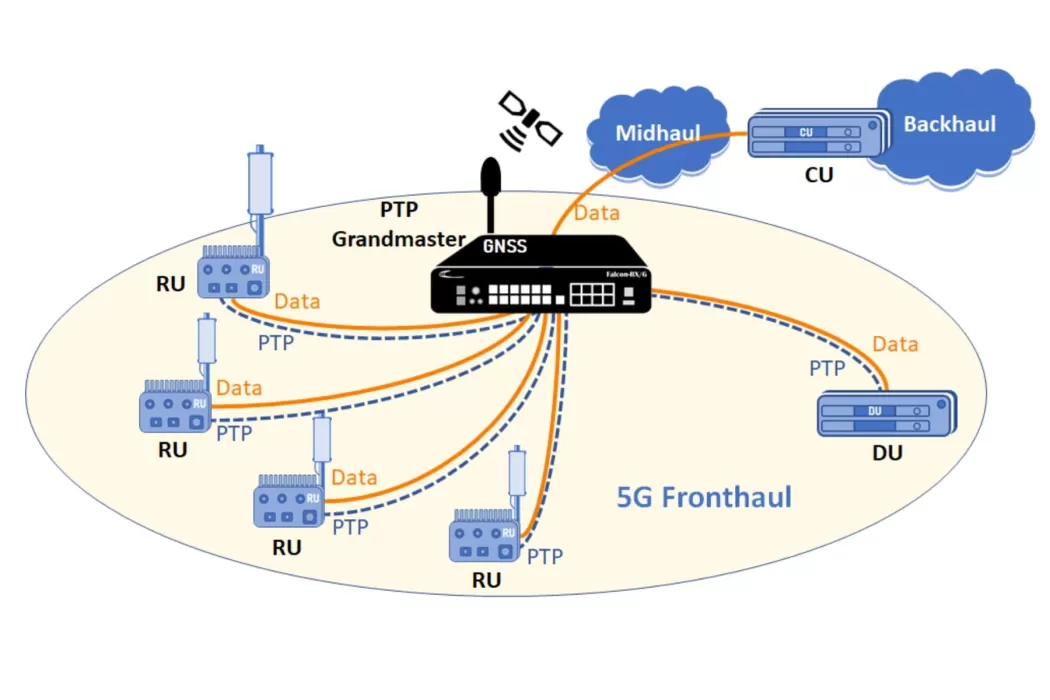
PTP operates using a master–slave architecture:
- A PTP Grandmaster acts as the main time source
- Slave devices receive timing information from the Grandmaster
- Time-stamped packets are exchanged to calculate delay and offset
By continuously adjusting clocks, PTP ensures all devices remain synchronized.
Accuracy of PTP
When implemented with hardware timestamping and proper network design, PTP can achieve nanosecond-level accuracy. This makes it suitable for even the most demanding applications.
Key Components of a PTP Timing Network
A complete timing network consists of several important elements:
- PTP Grandmaster
The PTP Grandmaster is the primary timing source in the network. It usually includes a GNSS receiver and generates accurate timing signals.
- Distribution Network
This includes switches, routers, and timing-aware network devices that transport timing packets. These devices must be designed to preserve timing accuracy.
- Slave Devices
Slave devices receive timing information from the Grandmaster and adjust their internal clocks accordingly. These can be base stations, servers, or network elements.
Each component plays a critical role in maintaining end-to-end synchronization.
What Is a PTP Grandmaster?
A PTP Grandmaster is the heart of a timing network. It acts as the reference clock and distributes precise timing information to all connected devices.
GNSS as a Time Source
Most PTP Grandmasters use GNSS (Global Navigation Satellite System) such as GPS to obtain accurate time from satellites. This ensures global time alignment and high accuracy.
Reliability and Holdover
In case of GNSS signal loss, a good PTP Grandmaster supports holdover capability. This allows it to maintain accurate timing for a certain period using internal oscillators.
How to Choose the Right PTP Grandmaster
Selecting the right PTP Grandmaster is essential for reliable network synchronization. Here are the key factors to consider:
- Timing Accuracy
Choose a Grandmaster that supports nanosecond-level accuracy, especially for LTE and 5G applications.
- GNSS Support
Ensure support for multiple GNSS systems such as:
- GPS
- GLONASS
- BeiDou
Multi-GNSS support improves reliability and availability.
- IEEE 1588 Profile Support
The Grandmaster should support relevant PTP profiles, including telecom profiles used in mobile networks.
- Redundancy and Reliability
Look for features such as:
- Dual power supply
- Redundant timing sources
- Automatic failover
These features improve network uptime.
- Scalability
The Grandmaster should support a large number of slave devices and work efficiently in growing networks.
- Security Features
Modern networks require protection against timing attacks. Support for authentication and security mechanisms is an added advantage.
Common Use Cases of PTP Grandmasters
- Mobile Networks (LTE and 5G)
PTP Grandmasters are widely used to synchronize base stations and ensure smooth mobile communication.
- Data Centers
Accurate timing helps with traffic management, logging, and synchronization between servers.
- Financial Trading Networks
Precise time stamping is essential for regulatory compliance and fair trading practices.
- Smart Grids and Utilities
Power distribution systems rely on accurate timing for monitoring and control.
- Media and Broadcasting
Audio and video synchronization requires precise timing to avoid delays and quality issues.
Benefits of Using a PTP Grandmaster
- High-precision time synchronization
- Improved network performance
- Reduced interference and errors
- Support for advanced technologies like 5G
- Scalable and future-ready solution
Best Practices for Deploying PTP Grandmasters
- Use hardware timestamping wherever possible
- Design the network with timing awareness
- Minimize network congestion
- Monitor synchronization performance regularly
Following these practices helps maintain long-term accuracy and stability.
Conclusion
As modern networks continue to evolve, precise time synchronization has become a fundamental requirement. PTP Grandmasters play a crucial role in delivering accurate frequency, phase, and time synchronization across packet networks.
With applications ranging from 5G and data centers to financial systems and smart grids, the importance of reliable timing cannot be overstated. Choosing the right PTP Grandmaster and designing the network correctly ensures high performance, reliability, and future readiness.
By understanding how PTP works and selecting the right components, network operators can meet the demanding synchronization needs of today’s digital infrastructure.


